特梅·拉西
Summary 摘要
In her interview with Lining Yao, Termeh Rassi explores how Yao’s pioneering work on “morphing matter” blends design, science, and AI to create materials that interact with and adapt to their environment. Yao shares her shift from medicine to design, her vision for embedding intelligence into physical materials, and her belief in AI as a collaborator in sustainability. Inspired by nature, she advocates for “physical intelligence” and systems that work harmoniously with ecosystems. Looking ahead, Yao envisions autonomous, biodegradable materials that restore environments, emphasizing human creativity and empathy as irreplaceable in shaping a sustainable, AI-augmented future.
在对姚励宁的采访中,特梅·拉西探讨了姚励宁在“变形物质”领域的开创性工作,即如何融合设计、科学与人工智能,创造出能够与环境互动、适应环境变化的材料。姚励宁讲述了自己从医学转向设计的经历、将智能嵌入物理材料的愿景,以及将人工智能视为可持续发展协作者的理念。她从自然中汲取灵感,提出“物理智能”的概念,并倡导构建与生态系统和谐共生的系统。展望未来,姚励宁希望开发可自主运行、可降解、能够恢复生态环境的智能材料,并强调人类的创造力与同理心在人工智能时代依然不可替代。
Chat 聊天

A still life of a simple brown paper seed packet lying on a scientist's workbench. Spilling from its open top are not seeds, but dozens of tiny, geometric, bio-degradable microchips and actuators, resembling a mix of organic seeds and sophisticated circuitry. The style is a detailed, high-resolution photograph with soft, natural light.
DEEPSEEK-V3.1 & MIDJOURNEY V7, AUGUST 2025
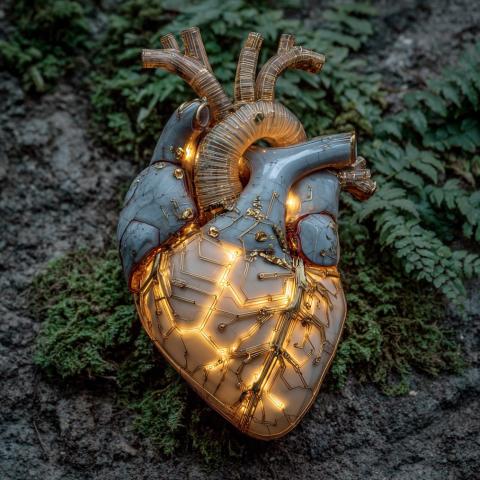
一件静物摄影:由半透明可降解聚合物雕刻的人类心脏与几何种子融合。表面蚀刻着发光蕨叶状电路,置于苔藓与原始土壤上。柔和戏剧性光线突出有机与合成材质的交融,象征物理智能及与自然的共生。
DEEPSEEK-V3.1 与 MIDJOURNEY V7,2025年8月