limp.freq

Artists

Mat Dalgleish

Year

2025

Materials

HTML and JavaScript, Processing and P5.js, Ollama (Qwen3 4B), ChatGPT, Python

Project Description

limp.freq deploys a population of self-navigating, cybernetics-inspired bots to examine how even relatively modest bodily asymmetries–exemplified by the artist’s own leg-length discrepancy (LLD)–shape behaviour not only at the scale of the individual (or the individual body), influencing posture, balance, and locomotion, but also generatively, as their effects cascade into collective perception, navigation, and environmental sense-making at architectural and spatial design scales.

Rather than celebrating bodily differences, most spaces still assume an imagined “standard” body–upright, symmetrical, mobile, two-handed, and two-legged (also sighted, hearing, and neurotypical). These presumptions may arise from explicit design choices, as in Le Corbusier’s Modulor man (the basis of the still-revered Unité d’Habitation), or more inadvertently, for example through the uncritical use of design tools that, in the name of effortlessness and usability, silently embed typical measurements. In either case, the frictions (or worse) encountered by non-normative bodies serve to expose how design is always a selective act, and how spaces encode assumptions about what is normal (and thus not just allowed but facilitated).

limp.freq is here presented as a series of five browser-based interactive simulations and nine still images created by these simulations, that, collectively, describe and document the divergent trajectories of two bot types, coloured green and orange. The orange bots are symmetric and approximate the efficiency-oriented behaviours privileged in standard algorithms, while the LLD-influenced, asymmetric green bots–less stable, more prone to fatigue, and in some cases actively avoiding less accessible terrain–produce slower, more messily meandering trails. However, these ostensibly “inefficient” paths reveal alternative cartographies of the 2-D and 3-D spaces used, foregrounding the epistemic richness of embodied variation and the limits of optimisation and universal design values.

In addition to contesting the normative spatial imaginaries through which bodies are measured, organised, and made legible–and in doing so calling for more pluralistic spatial thinking–the bots’ contrasting colours (green and orange) evoke two primal materials of early computing (phosphor and ferrite, respectively). Additionally, their underlying design is intentionally constrained so that the bots could plausibly have been (physically) built as contemporaries of Grey Walter’s tortoises (1949). Thus, a secondary and more subtly subversive function of limp.freq is to actively imagine–in the sense of speculative design–an alternative history of AI grounded in imperfection and diversity: a trajectory that challenges the persistent pursuit, fixed since the 1956 Dartmouth Conference, of order and perfection through abstraction (simplification) and exclusion.

Images
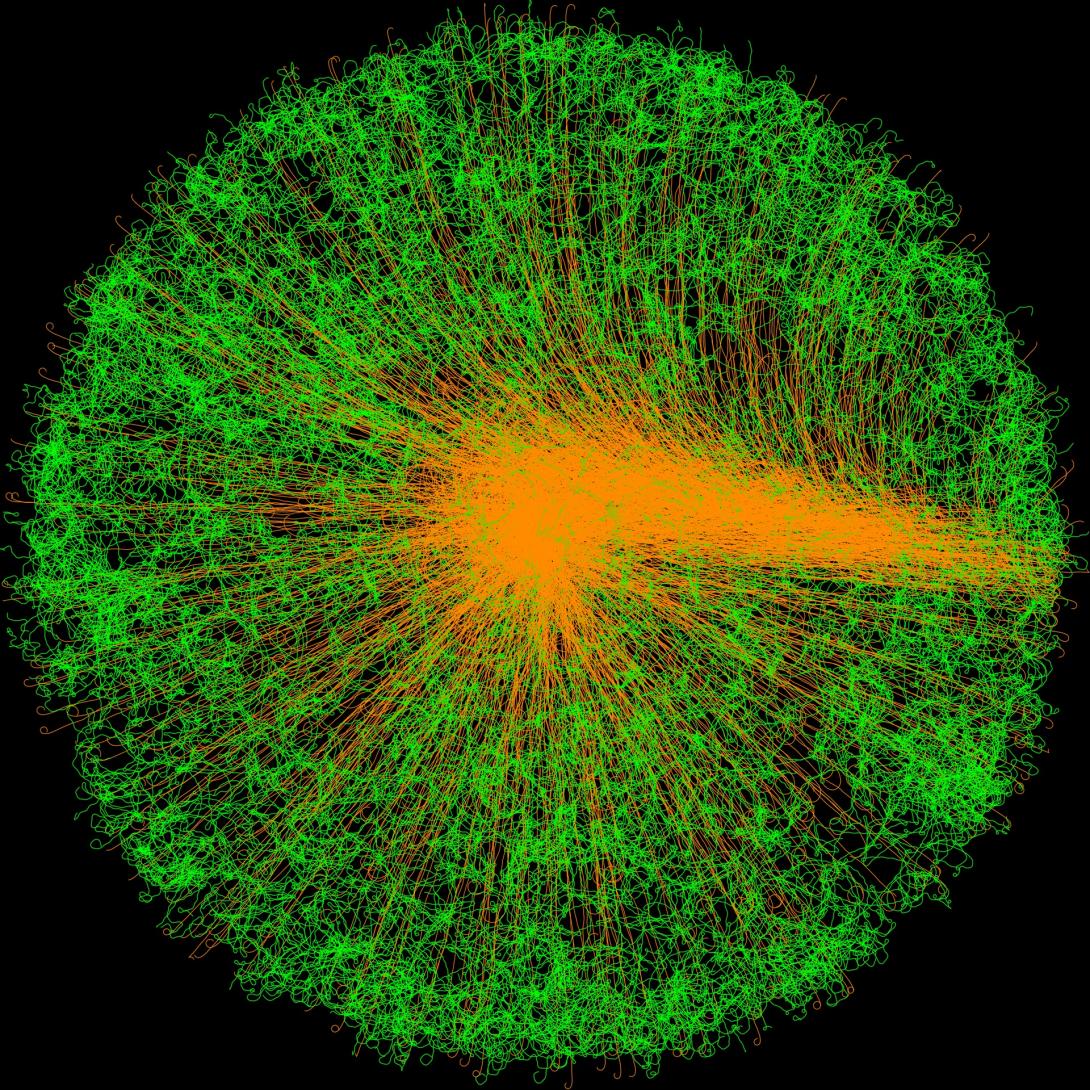
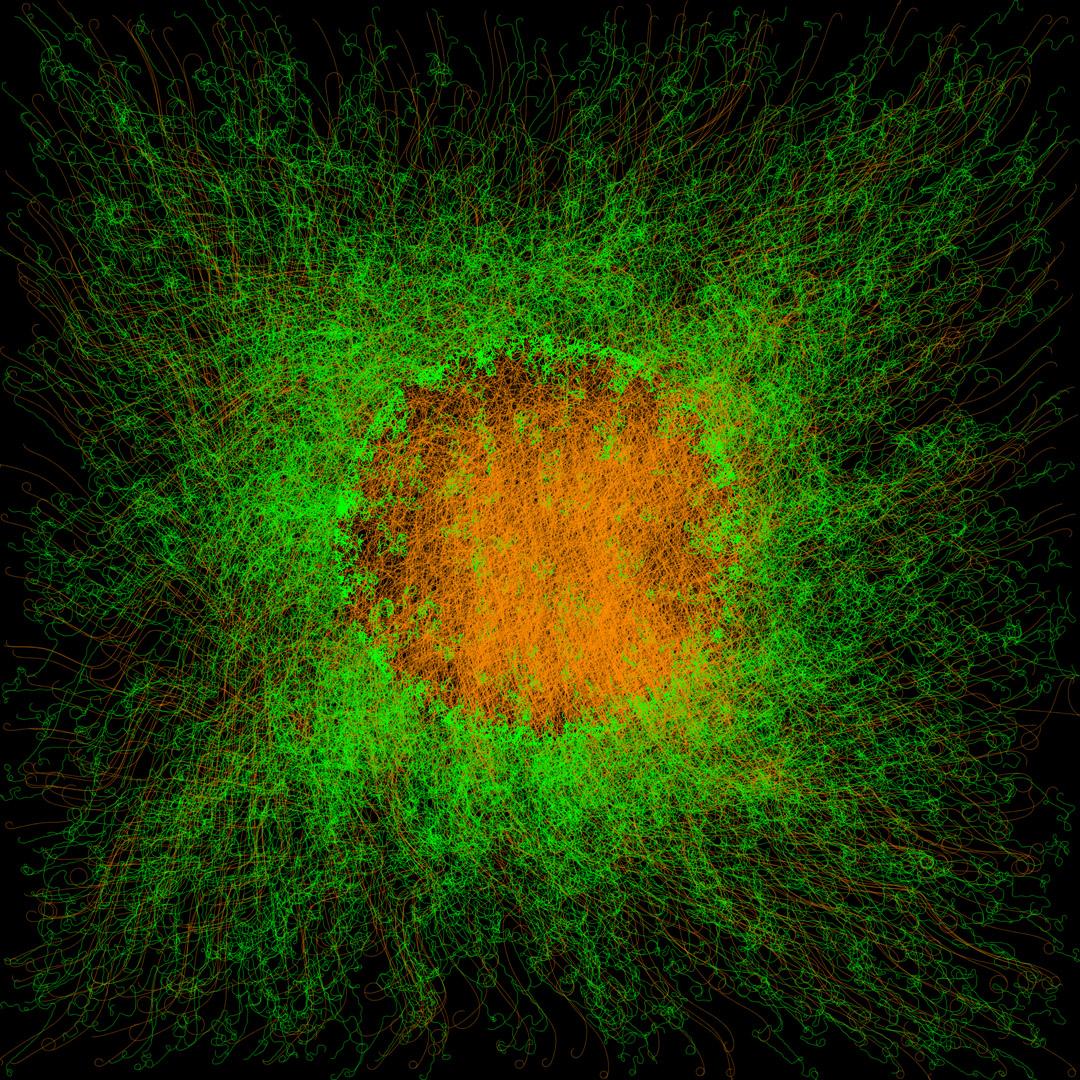
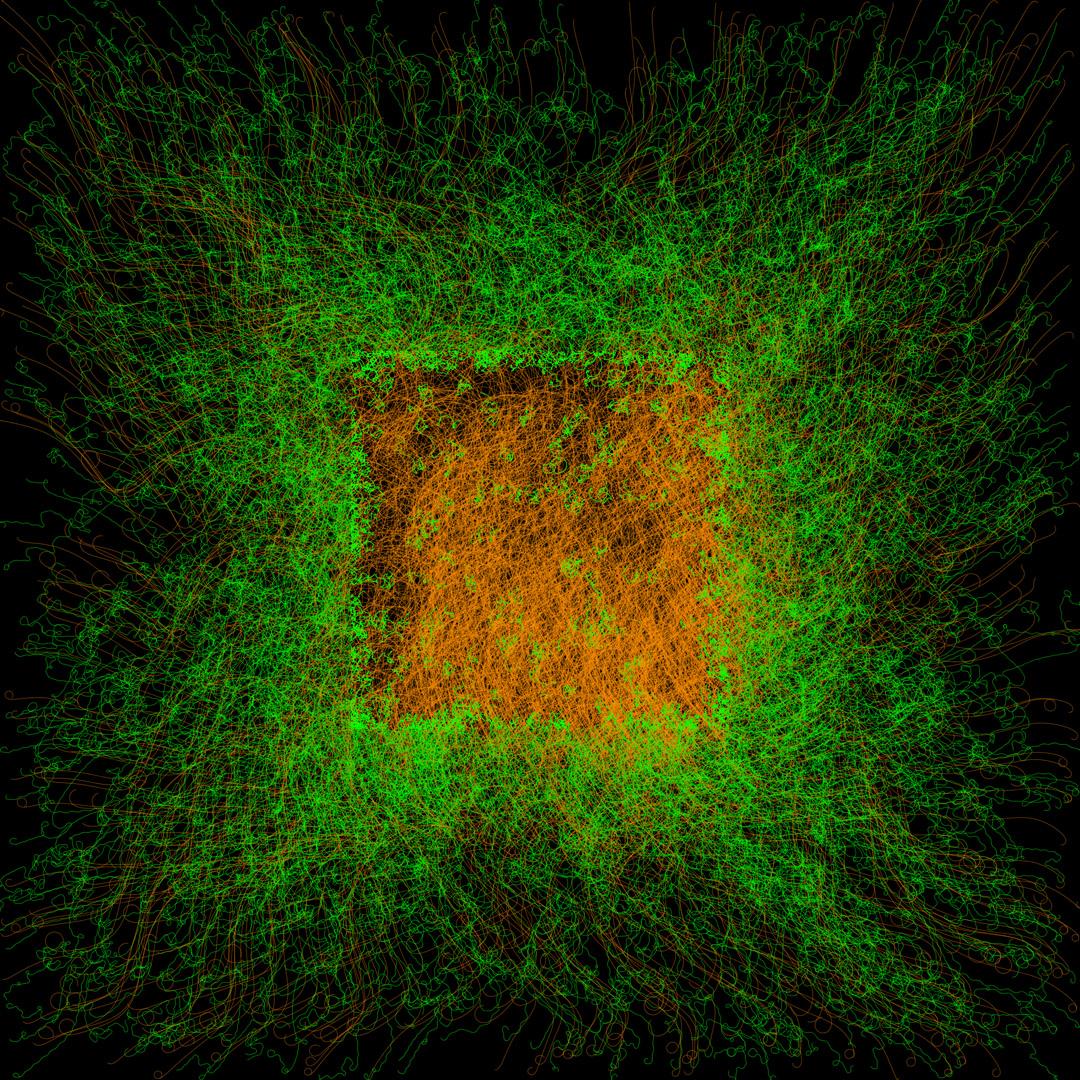
The image shows the trails of a population of bots as they move around a circular, 2-D world. There is a dense circular network of fine lines, radiating outwards from a bright orange center into a surrounding field of green filaments. The orange area in the middle is tightly packed, suggesting a point of high, focused activity, and it pulls out as a kind of streak towards the right side, angled slightly downwards. Moving towards the edges of the image, the lines are far more often green, tangled, messy, and dispersed, forming a roughly spherical shape against a black background. The overall structure resembles a data network, particle simulation, or neural map, with a clearly gradiated density that changes from a concentrated core to a relatively diffuse outer region.
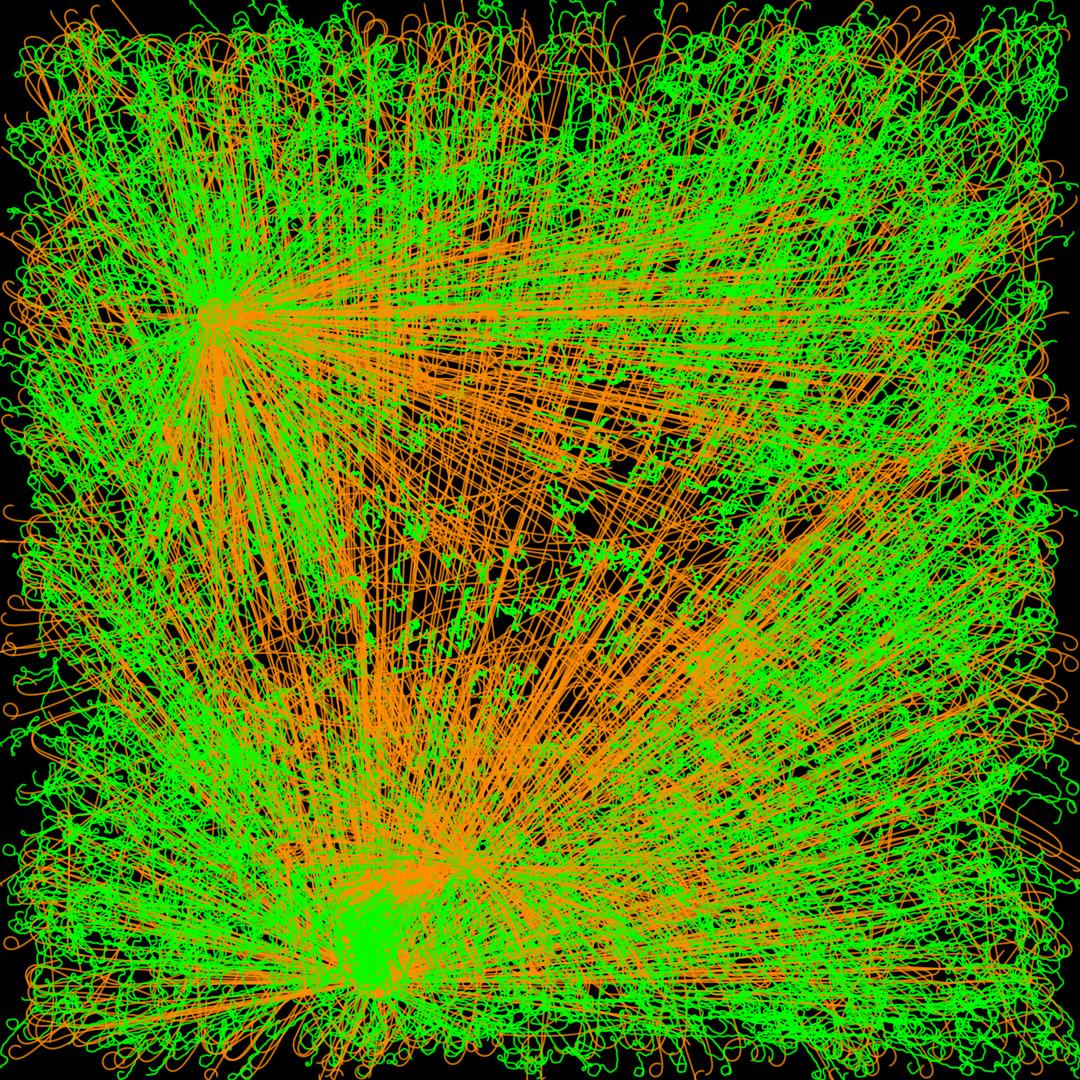
The image shows a dense, square-shaped network made up of thousands of intersecting orange and green lines on a black background. Several bright clusters of orange lines appear as focal points, from which both orange and green lines radiate outward in many directions. The green lines form looping, tangled paths that fill almost the entire frame, overlapping and crossing repeatedly. The orange lines are more direct, much straighter, and concentrated near the bright clusters, suggesting areas of higher activity or connection. The overall effect is that of a complex, layered web or map with multiple centers of intensity spreading through a grid-like field.
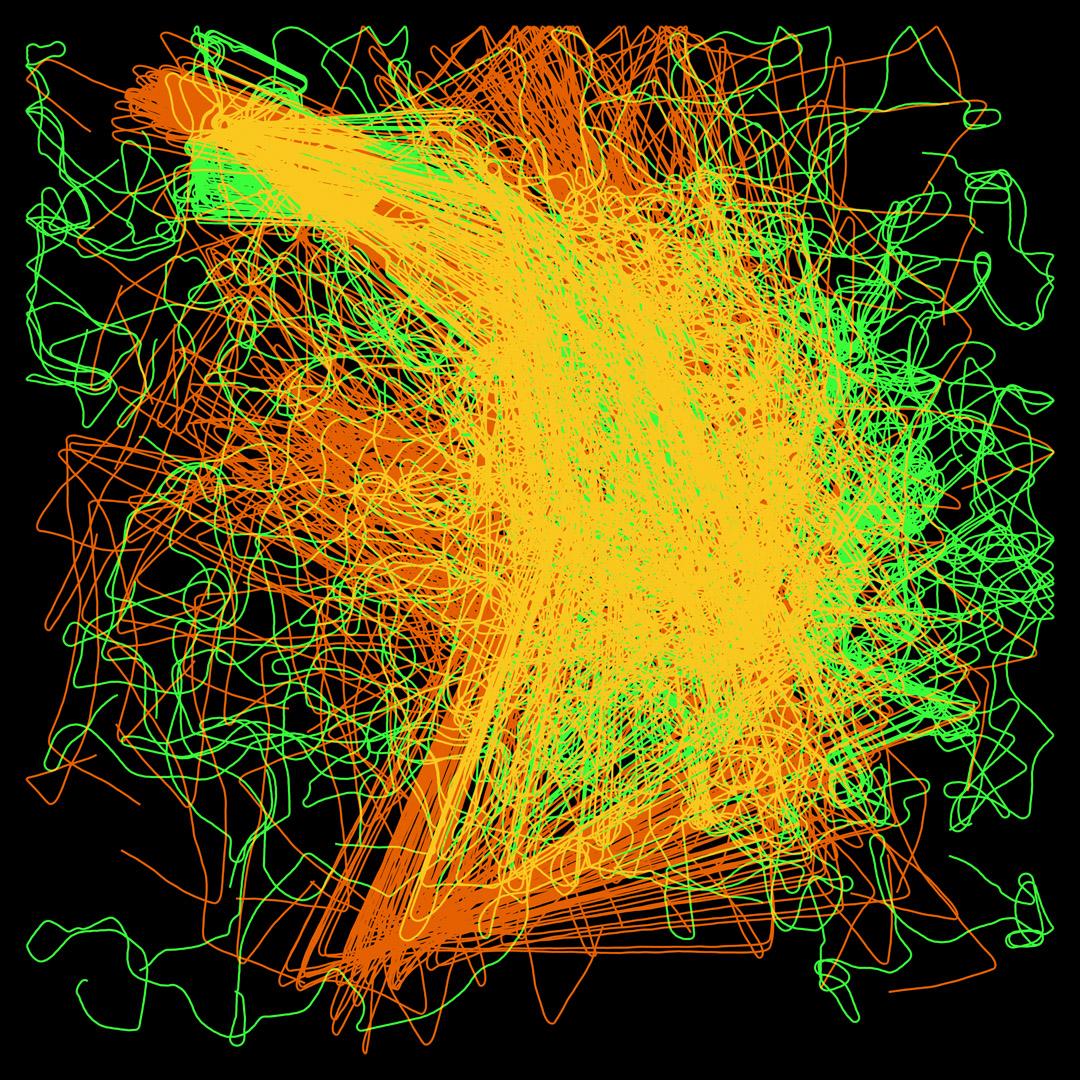
The image features a dense, swirling field of motion, made up of thousands of overlapping lime green and amber-orange lines - the trails of bots inscribed across a deep, black background. The green lines are typically thinner, nervous, and darting, looping freely around the edges like unstable electrical signals, while the orange lines are generally thicker (the result of multiple lines being overlaid in close proximity) and more forceful, gathering heavily toward the centre. Where the two colours intersect, they create a bright, hazy yellow core - an almost glowing mass where a great many paths collide and blend. From this luminous centre, trails seem to shoot outward in every direction, thinning into wandering curls and tangled knots that sprawl to the edges of the frame. The whole composition feels restless, as though capturing the long-exposure traces of many unpredictable agents moving at once. The overall sensation is of turbulence, energy, and chaotic motion, with no clear beginning or end - just variously contrasting and overlapping colour and movement suspended in darkness.
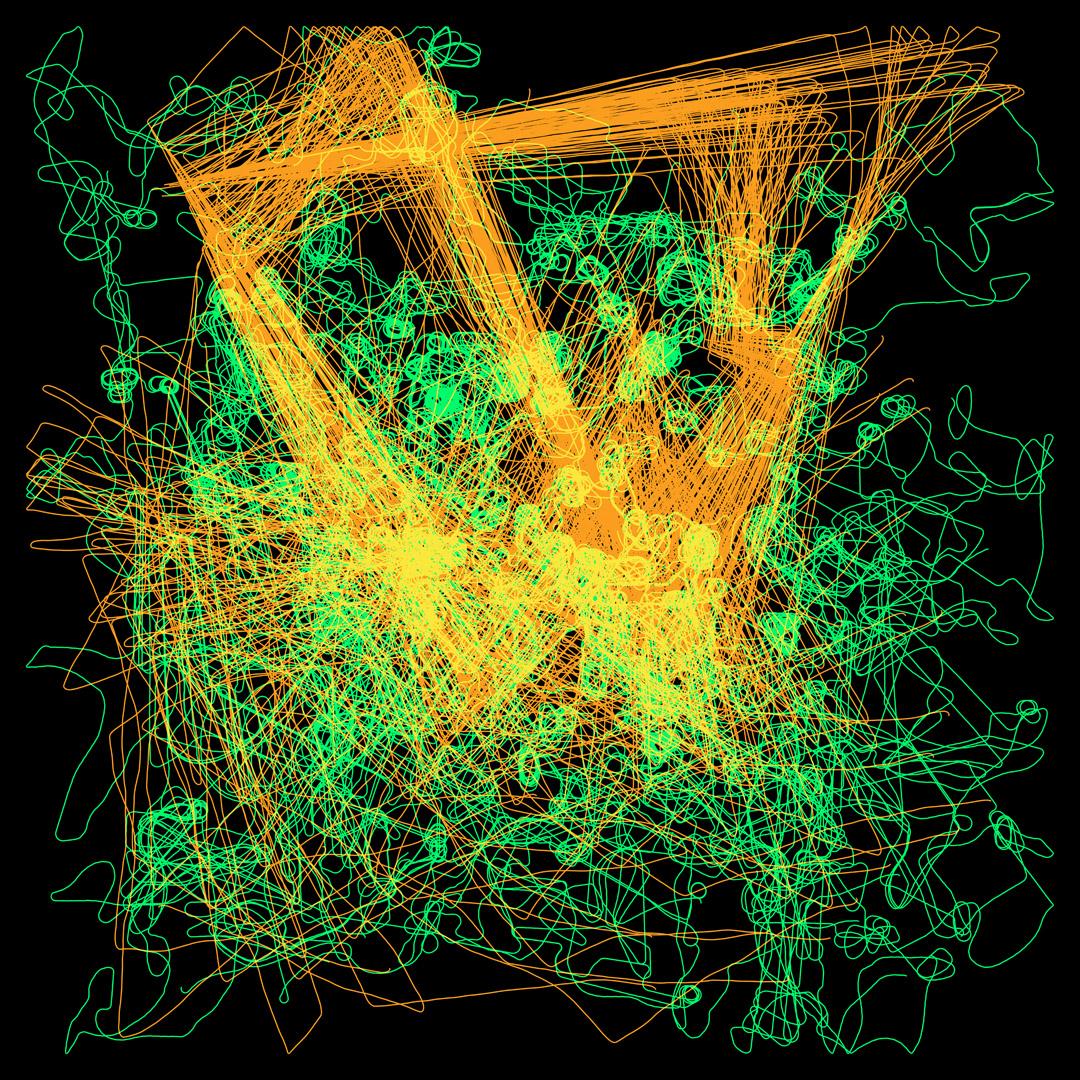
The image features a dense, chaotic web of orange and green lines on a black background. The orange lines form sharp, angular structures that crisscross diagonally through the center, creating overlapping triangular and rectangular shapes. In contrast, the green lines are looser and more fluid, looping and curling irregularly around and between the orange shapes. The composition feels layered and tangled, with the orange lines suggesting rigid frameworks or trajectories and the green lines appearing more organic and dispersed. Overall, it resembles a complex network or collision of geometric and freeform motion within a confined square space.
The image shows a dense, circular formation of orange and green lines against a black background. At the center is a bright, tightly packed orange core made up of countless fine lines crossing and overlapping. From this central area, green lines extend outward in all directions, gradually spreading and becoming more tangled and irregular toward the edges. The overall structure resembles a burst or diffusion pattern — concentrated and energetic in the middle, more chaotic and dispersed at the periphery. The green lines create a soft, textured halo around the orange center, giving the image a strong sense of depth and outward motion.
The image shows a dense rectangular cluster of orange lines at the center, surrounded by a thick layer of tangled green lines that radiate outward in all directions. The orange region is compact and intensely textured, with many overlapping strokes forming a solid, glowing block. Around it, the green lines twist and loop outward, creating a fuzzy, irregular border that gradually becomes more diffuse toward the edges. The overall composition has a strong central focus, with the orange core suggesting concentrated energy or structure and the surrounding green filaments giving a sense of motion and dispersion.
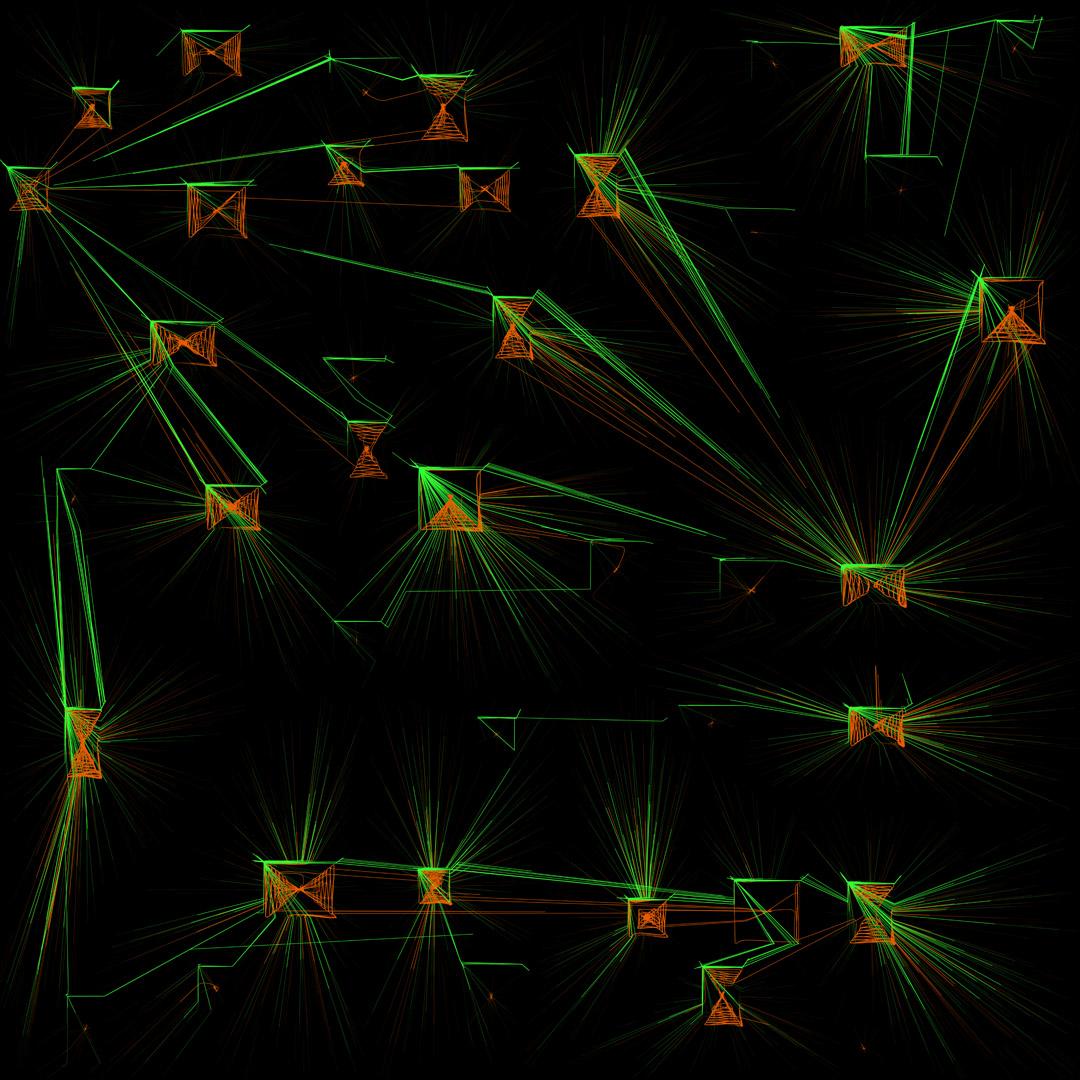
The image displays a black background overlaid with a network of geometric shapes and straight lines in green and orange. Each shape appears as a small polygon or cluster of triangles, with multiple thin lines radiating outward from its center in all directions. The green and orange lines frequently intersect, forming dense starburst or web-like patterns.
Some shapes are connected to one another by longer, angular lines, creating a loose network that extends across the entire image. The overall arrangement is irregular but balanced, with clusters of shapes distributed throughout the frame and areas of denser connectivity interspersed with more open space. The image has a technical or diagram-like quality, resembling a stylised visualisation of a network or data system.
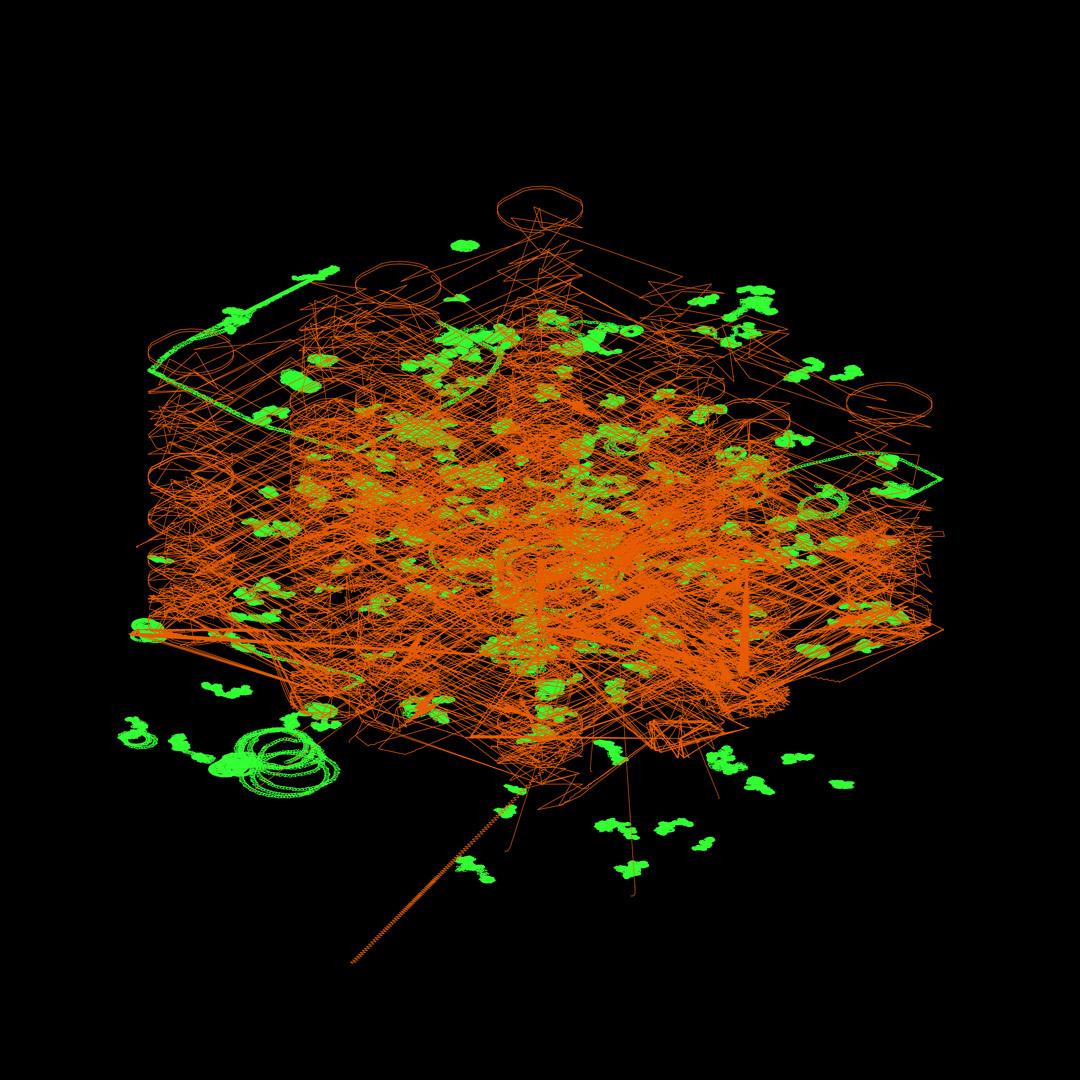
The image consists of a black background with a densely packed orange wireframe structure occupying most of the central area. The structure is composed of numerous straight lines forming interconnected geometric shapes, including cubes, hexagons, and diagonal cross-braces. The lines overlap heavily, creating a layered, mesh-like effect. Distributed throughout and around this orange structure are multiple green circular and spiral forms of varying sizes. These green elements are less densely arranged and appear to be positioned both within and outside the main orange cluster. The composition is symmetrical along no clear axis, with the orange structure concentrated in the center and the green shapes more dispersed toward the edges. The image gives the impression of a three-dimensional lattice viewed from an oblique angle.
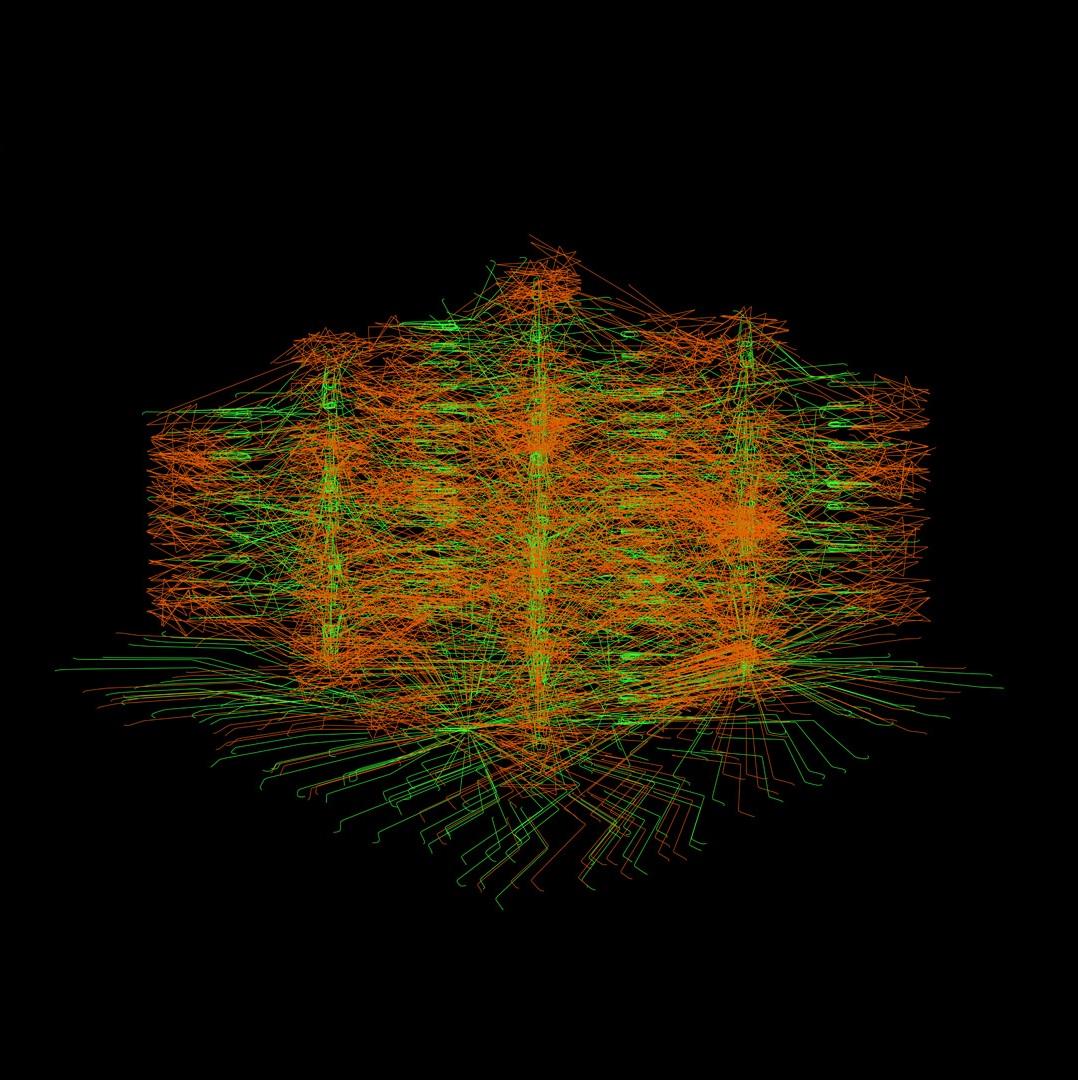
The image shows a cluster of intersecting lime green and amber-orange lines set against a pure black background. The structure they imply is architectural and grid-like, as though many separate movements have been forced into a shared, rigidly walled, three-dimensional structure. At the centre is a dense block of orange strokes, layered so heavily that they form a textured, almost woven core. Threading through and around this are sharper, straighter green lines (showing the different routes that green bots are forced to take compared to the most efficient routes of orange bots) that give the whole shape a mechanical, skeletal rhythm, like circuitry or scaffolding. The structure widens toward the middle, then narrows at the top and flares at the bottom, creating an abstracted silhouette reminiscent of a stacked tower, or a vibrating hive. At the lower edge, green and orange lines shoot outward in brisk, angular directions, like a breaking free from the containment of the structure. The overall sensation is of two visually distinct kinds of constrained movement and energy.

Interactive Simulations

The six images below link to interactive simulations in a new tab. A description is available beneath each link.
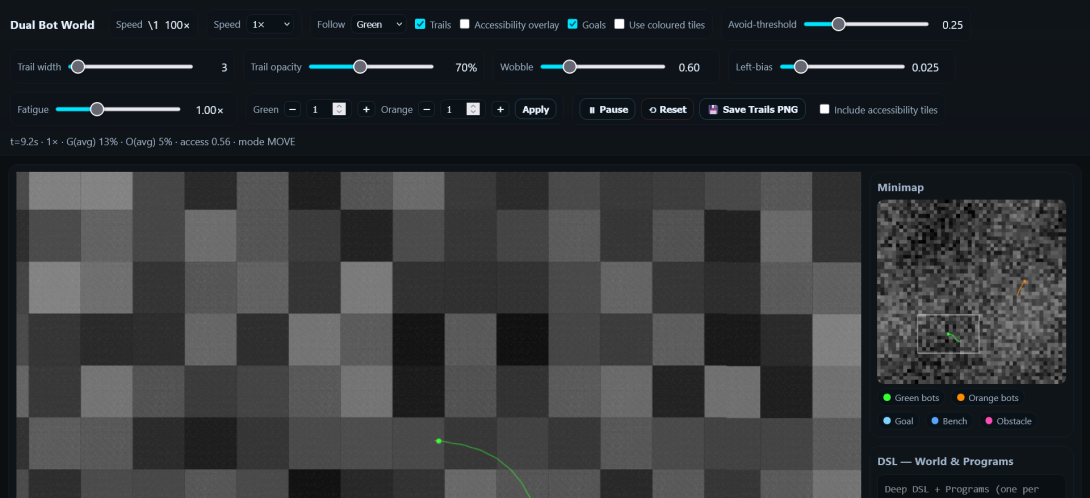
Dual Bot World page. The interactive simulation is not screen reader accessible. A description is available below.

Simulation 1 (Introducing Asymmetry)

Two populations of autonomous, self-navigating bots - green and orange - navigate an algorithmic landscape of varying accessibility and resistance. They leave trails not only as records of movement but as inscriptions of effort: coloured traces shaped by divergent needs for energy, rest, and the avoidance of obstacles and the physically inaccessible. Built as part scientific model and part poetic system, the simulation reflects a world in which movement in space is never neutral. Each bot’s gait, bias, and exhaustion instead reveal a microcosm of embodiment - of how spaces and their systems accommodate or constrain difference. The asymmetric green bots are bent by design: their limping, slower cycles are not defects but alternate spatialties and temporalities that make visible what efficiency hides. Simultaneously, the more linear, efficient orange bots trace the normative expectation of continuous productivity and the standard(ised) algorithm. What emerges is not competition but a kind of cohabitation - a choreography of uneven agents whose differences serve to highlight the need for more pluralistic and inclusive spatial thinking.
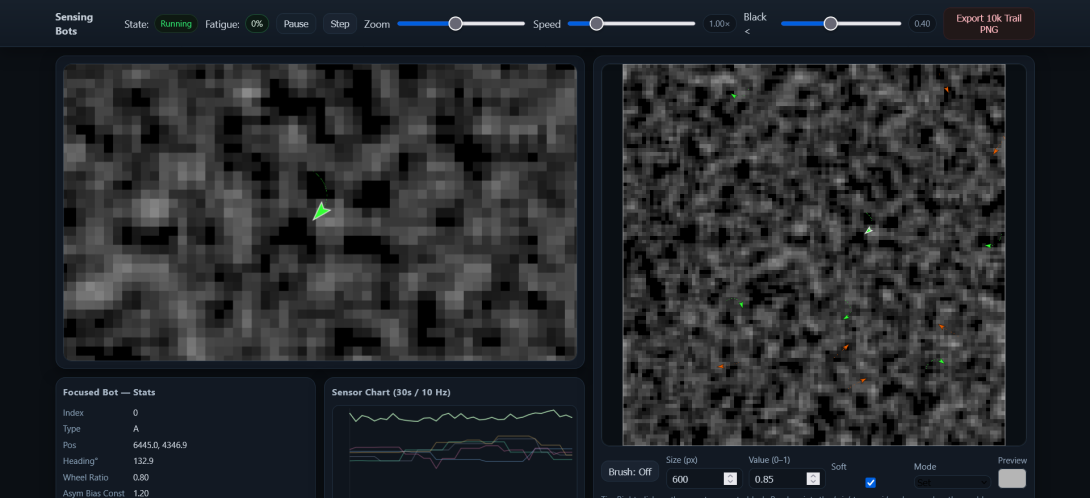
Sensing Bots page. The interactive simulation is not screen reader accessible. A description is available below.

Simulation 2 (Sensing the World)

A population of orange and green bots, similar to the first simulation, moves through a shared, randomly generated environment. The perceptual capacities of the bots (i.e. their ability to sense their environment) are limited but equal, yet they differ significantly in their capacities for locomotion, fatigue, adaptation, and rest. The resulting behaviours are embodied rather than optimised, forming a rich micro-ecology of sensing and (divergent) response. Yet this is only one configuration or set of possibilities among many - a main difference with this simulation is that almost every aspect of the simulation can be reprogrammed by the user. As well as more superficial customisations, the orange-green difference, for instance, might be maximised or minimised, concealed or caricatured.
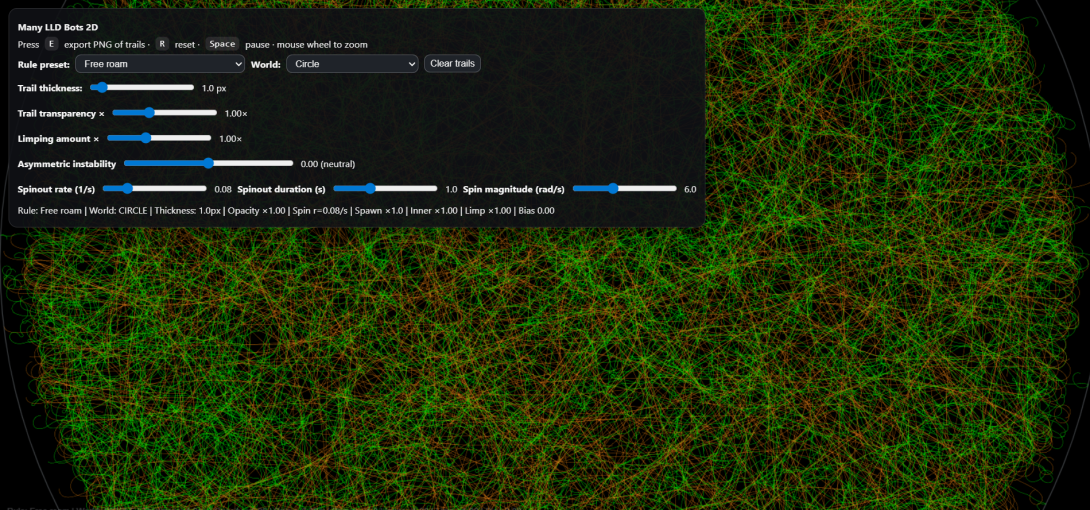
Many LLD Bots 2D page. The interactive simulation is not screen reader accessible. A description is available below.

Simulation 3 (Scale)

Hundreds of orange and green semi-autonomous agents drift, navigate around, and adapt to a digital world mutable in shape and access. The simulation explores embodied, divergent motion at scale - how simple asymmetries impacting localised locomotion, fatigue, and instability can produce complex, emergent ecologies of large-scale spatial behaviour.
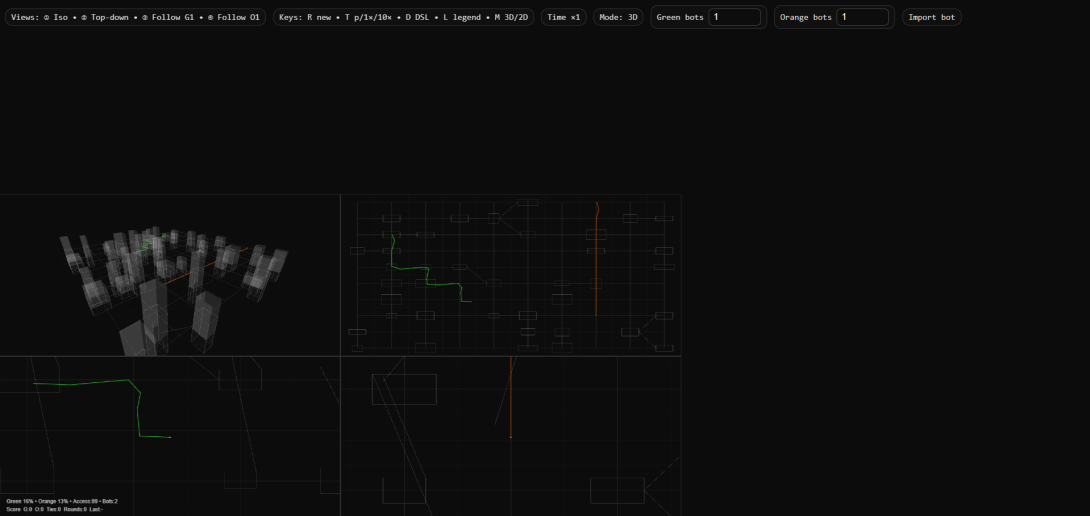
View Wireframe City Bots page. The interactive simulation is not screen reader accessible. A description is available below.

Simulation 4 (Multiple Perspectives)

Hundreds of orange and green semi-autonomous agents drift, navigate around, and adapt to a digital world mutable in shape and access. The simulation explores embodied, divergent motion at scale - how simple asymmetries impacting localised locomotion, fatigue, and instability can produce complex, emergent ecologies of large-scale spatial behaviour.
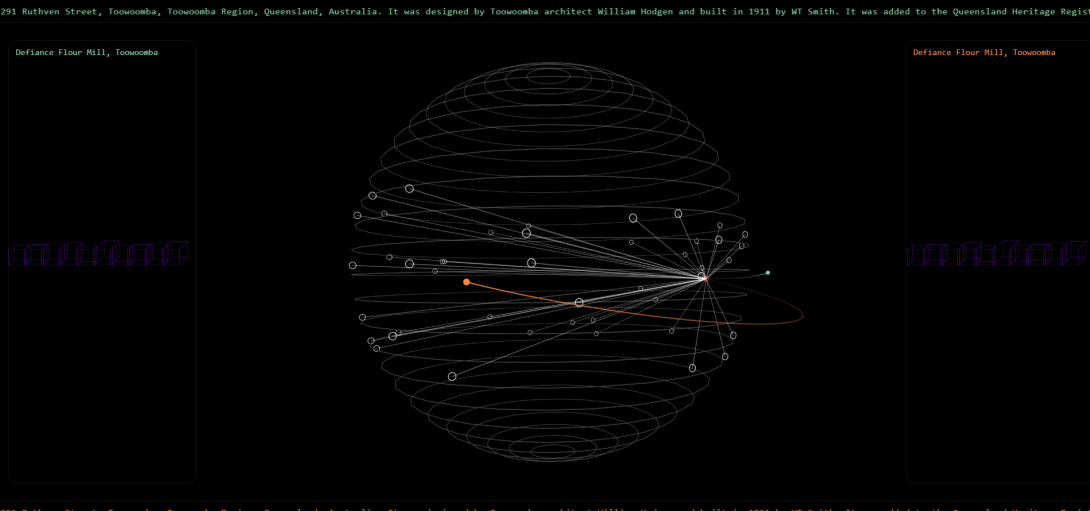
Planetary Network page. The interactive simulation is not screen reader accessible. A description is available below.

Simulation 5 (Knowledge)

The green bot moves slowly, unevenly. Its asymmetric body consumes more energy; its motion drifts and wavers. As it traverses a boundless archive, difference in movement becomes difference in knowledge, and that knowledge, in turn, materialises as difference in structure. Its architectures are not errors but translations of experience - physical records of how imperfection, detour, and persistence create new ways of knowing. In this endless, Babel-like library, where every possibility exists, the green bot finds meaning not through speed or order, but through encounter.
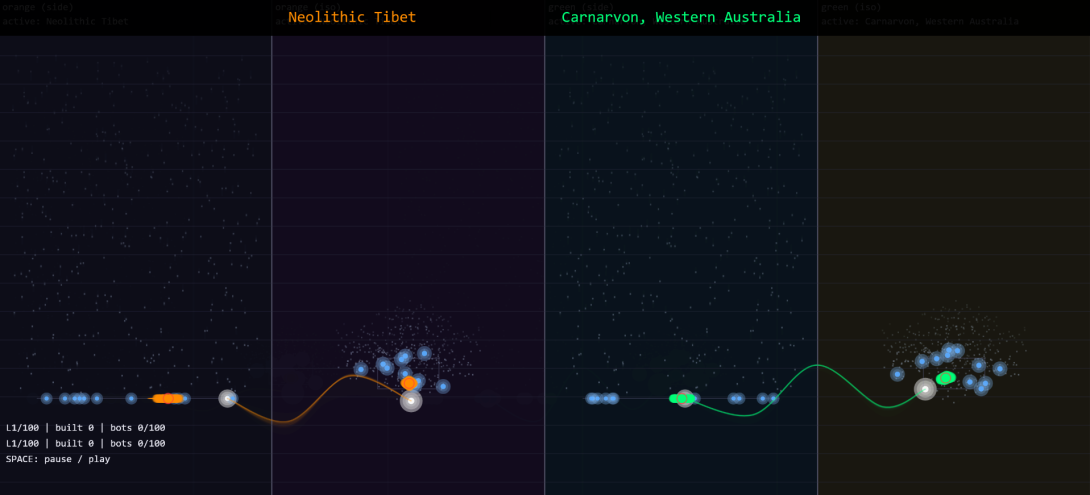
Simulation 6 page. The interactive simulation is not screen reader accessible. A description is available below.

Simulation 6

The bots move through knowledge-containing structures unevenly, each different cache of knowing actively sculpting the architectures that rise from them, less built than manifested, each a trace of the particular way the respective bots understand their world.

Documentation