Artist
Year
2025
Materials
AI Models: Midjourney, Gemma, Chat GPT, Dream Studio,, Llama 3:11 B visual, Stable Diffusion, Firefly, Stability A
Software: Photoshop, InDesign, Blender, Unreal Engine, WebGL
Hardware: Mac M1, PC
Paintings: Linen or Cotton Canvas, acrylic paints, gels, oil sticks, pastels, collage items (printed paper, lace and 3D printouts)
Project Description
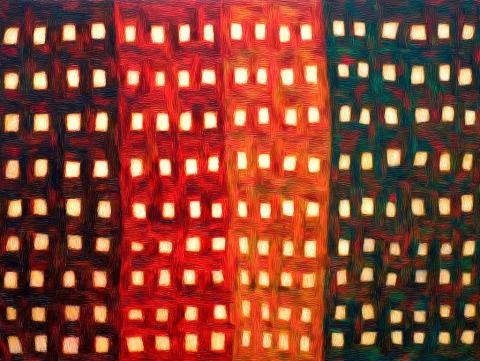
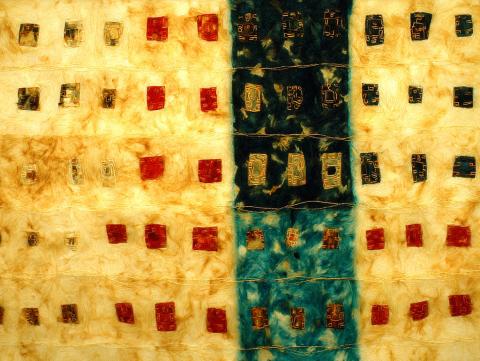
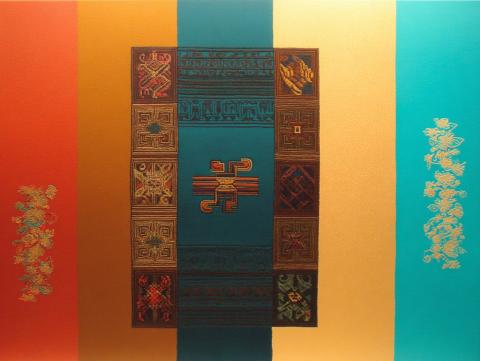
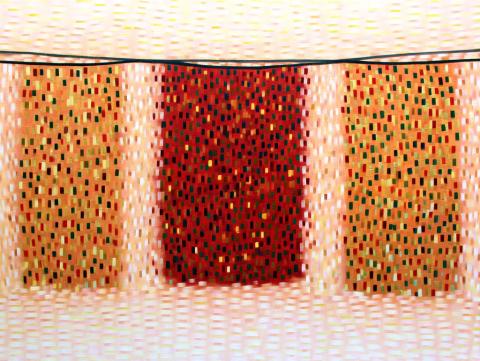
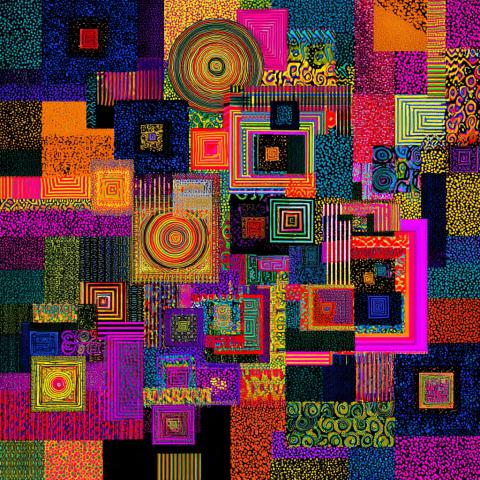
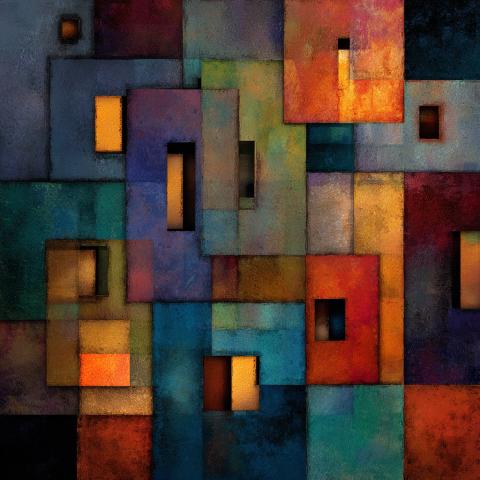
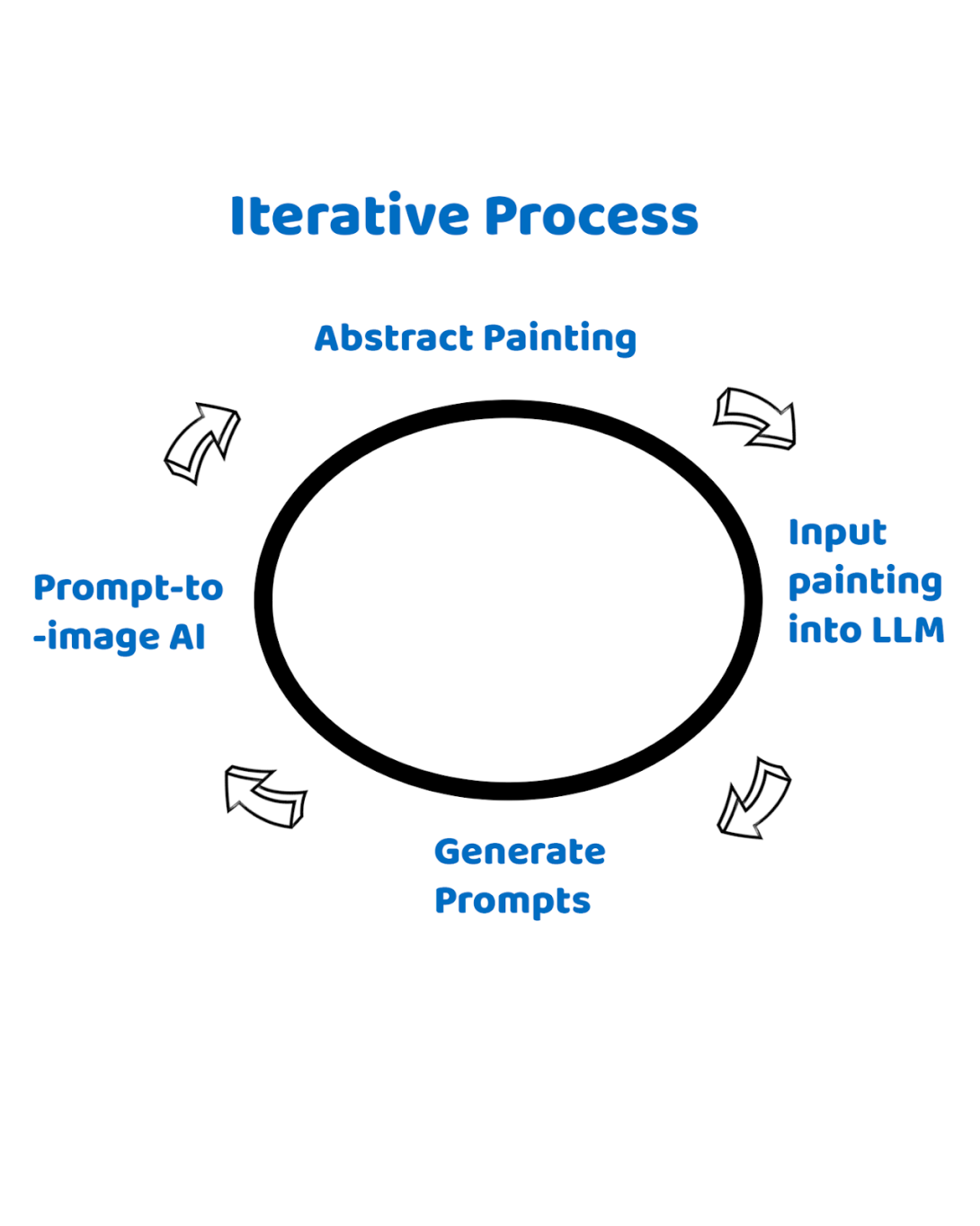
Movement in Squares is a meditation on collaboration between the human hand and algorithmic intelligence—an evolving dialogue between the tactile and the digital. Lucia Grossberger Morales uploads her abstract painting to a large language model for description, then uses that description to generate a prompt for AI image generation. From paint to text to image and back again, the process forms a living feedback loop of intuition and computation, each iteration expanding the conversation between mind and machine.
The act of painting is slow, embodied—a tactile dialog in color, texture, and form. The square is both a psychological and a cultural symbol, grounding and echoing Bolivian weaving and Incan geometry. AI operates with near-instant precision—swift, disembodied, and spectral—while painting unfolds slowly through feeling and touch. Between these tempos arises a hybrid practice of translation and reinterpretation. Each cycle—painting, prompt, image, animation—becomes a meditation on the act of transformation itself.
Movement in Squares reveals how language, color, and technology can converge into a living system of creative exchange. In this system, the sacred geometry of the square breathes anew through the embodied, felt human experience combined with the circuitry and programming of the machine.
Text Sparks Pixels Dance Gallery
This is an interactive gallery of images from Movement in Squares. Screen reader users can read or listen to a full description of the scene here.
To move around the scene, click into it and use your arrow keys or WASD keys. To pan the camera, hold and drag with your mouse.
Description
Text
You enter a rectangular room enclosed entirely by walls of text. Every surface — floor, ceiling, and the surrounding walls — is covered edge to edge with dense black words. These are the prompts that generated the images in the exhibition. Among the words, some lines glow with color: navy, phosphorescent yellow, green, red, and soft blue.
These phrases have been highlighted for their sound and rhythm — fragments that shimmer with unexpected poetry. A line might read: “The image appears like a woven cosmos” or “ in translucent veils, revealing traces of under color and time.” In this environment, text becomes both architecture and atmosphere — you are walking inside language itself.
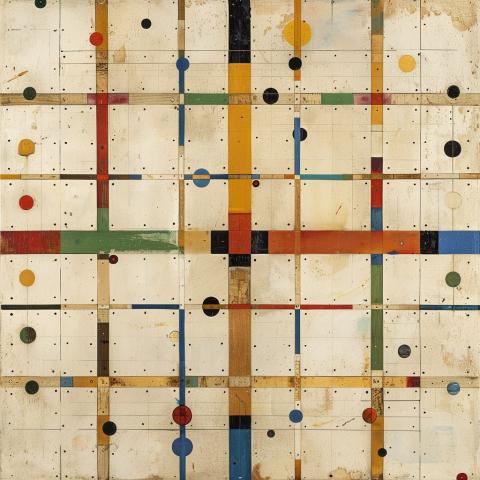
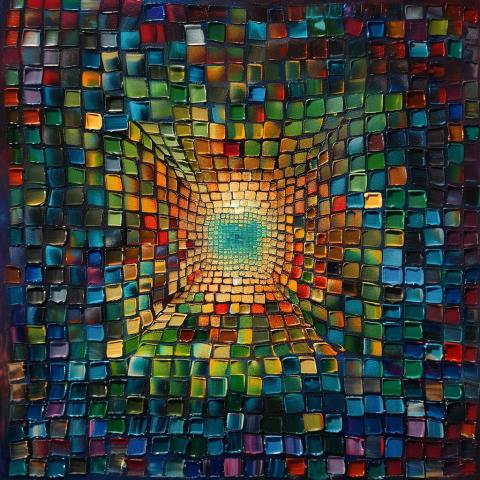
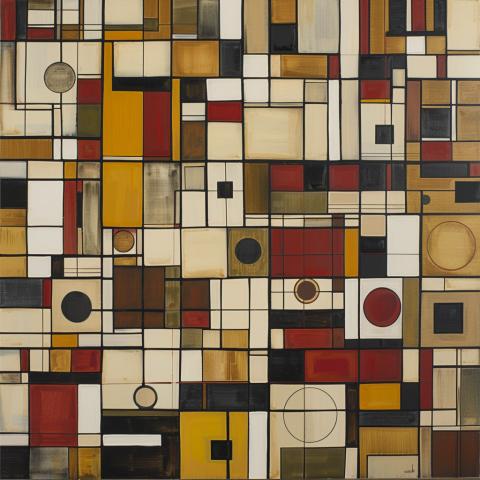
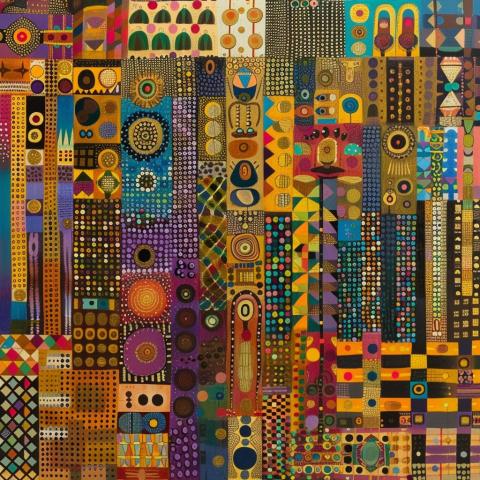
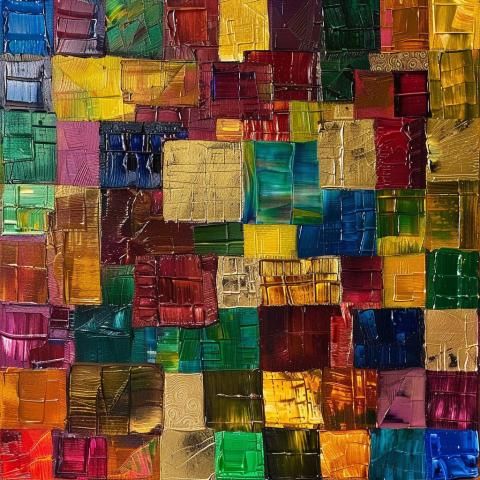
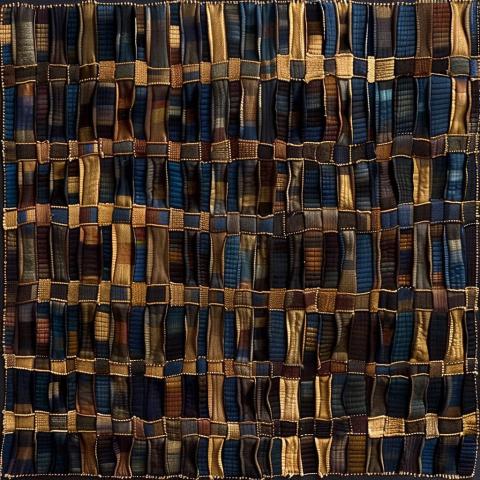
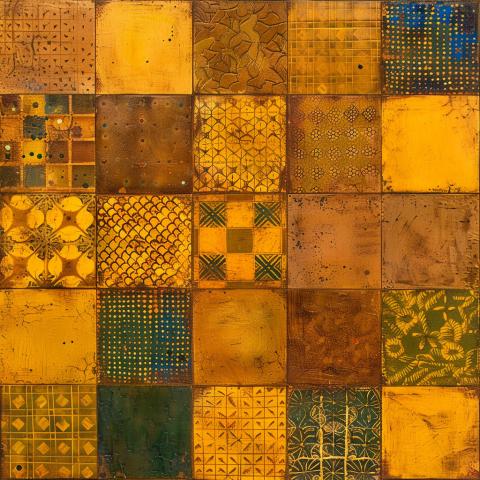
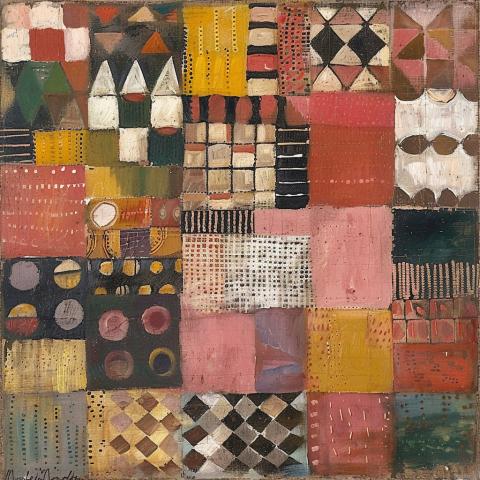
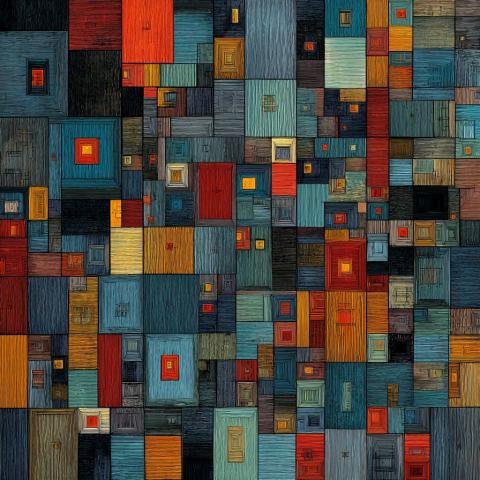
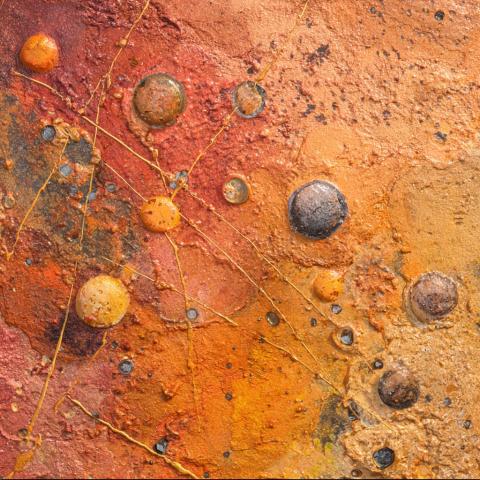
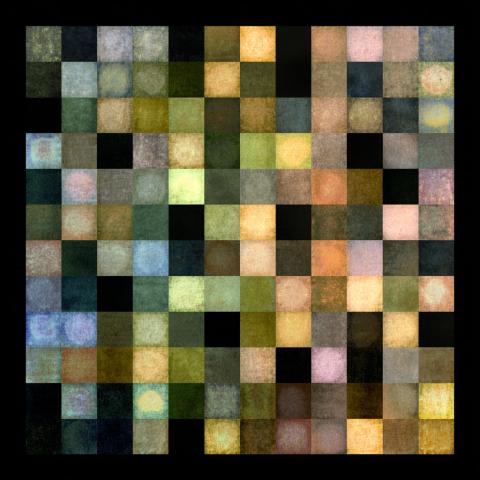
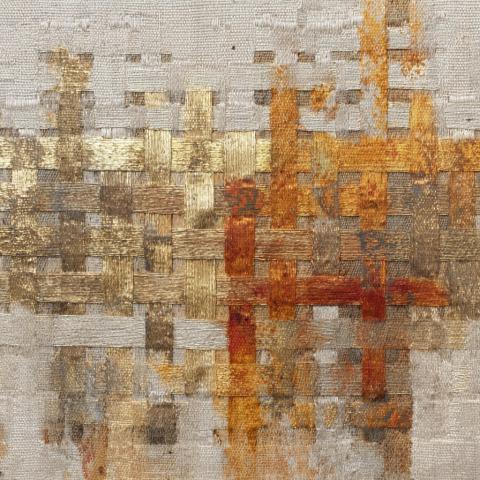
Four freestanding panels stand in a line before you like stations for thought, each a different color — from left to right: seafoam green, rust, navy blue, and pale salmon. Mounted on them are samples of AI-generated images—meditations on translation between the verbal and the visual. I uploaded photos of my abstract painting to a multimodal LLM and requested a description. I used the description as a prompt to generate an AI image. The images and prompts bear little relation to the original painting, reminding me that words and images are different modes of information, and that translation is poetic at best.
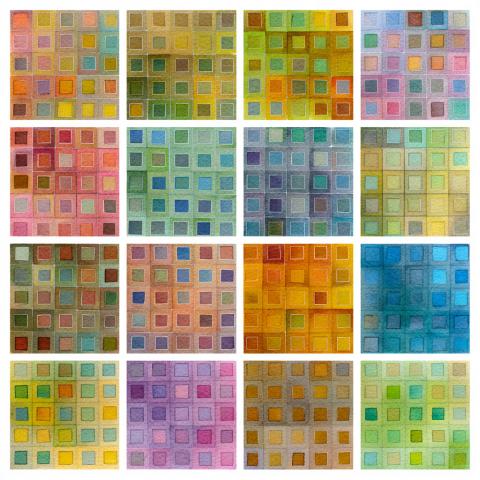
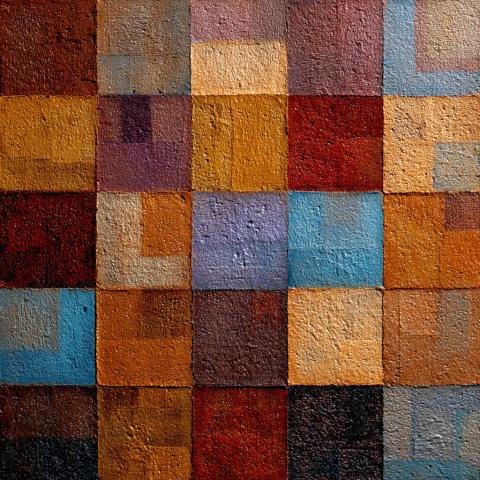
The generated images, in turn, inspired me to begin another painting. And the process continued, generation after generation —a translation from hand to algorithmic word and image, then returning to human hand, to embodiment. On both sides of the seafoam-green panel, six squares glow in soft greens, oranges, and whites—grids breathing with a quiet, organic rhythm. The rust wall shimmers with different-sized rectangles of warm light—orange, beige, yellow—its uneven textures recalling woven cloth and sun-baked clay. The navy wall gathers a quiet depth—six luminous squares burning at its front, while behind, bold heraldic forms in red, black, brown, and white stand like emblems of order.
On the front of the pale salmon panel, six calm and delicate grids appear in pale tones, and on the back, painterly abstractions that blur geometry into gesture. Everywhere, words shimmer—echoes of the language that summoned this vibrant constellation of images ranging from the tactile and organic to the saturated and structured, and finally to the soft and meditative. Words now surround these generated images in a halo of a machine generated poetic collage.
Audio (English)
Audio (Spanish) - Narration by Neyda Larson
The following media is presented as a YouTube player embedded in Able Player.
Movement in Squares
Movement in Squares is an iterative cycle between human creativity and machine creativity. I uploaded an image of my abstract painting to an LLM and requested a description. I use the description as a prompt for Midjourney. After studying dozens of generations of AI, I started a new painting. And the process continued, generation after generation.
I was born during the Bolivian Revolution and emigrated to the United States at three. Because of the loss and displacement, I developed debilitating asthma and, fifteen years later, bipolar disorder. The effects have restricted my social life, and for most of my life, I have found it easier to spend time in my studio creating than to be with other people. My moods can be extreme, and they fuel my creativity, which is the best way I know to stabilize them.
I consider painting a form of meditation, both a practice and a way of being with the canvas. Instead of aiming for a finished object, I focus on the process: mixing color, feeling texture, repeating forms, allowing images to arise and dissolve. My abstracts begin with simple concepts, such as bold colors, circles, hard lines, or earthy colors. These concepts set my intuition working within those parameters.
The painting is a dialogue. I add a few marks and wait for the painting to respond. When it responds, I feel it in my chest, and it extends to my hand and paintbrush. I value that conversation—I am conversing in the language of my soul, the language of color, form, and movement.
The forms in my paintings vary depending on my feelings during that period. When life is lively and I feel expansive, I paint bright, abstract paintings with movement throughout the canvas. When life feels chaotic, I paint squares. Squares are grounding. They are containers, boxes that do not roll away. In an unstable world, squares give me stability. The square is the house I build when the world is too much.
Painting squares is not only a psychological phenomenon for me but also a cultural one. In my homeland, Bolivia, the square is the dominant shape. For example, the actual name of the Incan empire is Tawantinsuyu—the land of four corners. Incan ponchos were adorned with "tocapus," woven squares filled with designs that served as visual markers of the wearer's place in the community.
The square is an archetype of stability, but like all archetypes, it carries its opposite. The square is also a confinement. To be boxed in is to be restricted. I wrestle with this paradox of stability and creativity on the canvas. My challenge is to make squares breathe, to create movement inside them so that stability does not become stagnation.
My painting process is slow, physical, and tactile. I spend hours bringing a painting into being, layering hues, scraping back, reapplying. This slowness allows unconscious connections to emerge. The colors and the intentional movement give me a feeling of agency. With each stroke, I am transforming my visual world. Painting is healing. Color, form, and motion move through time, just as emotions do.
AI is fast. Things whiz by at a rate of more images per minute than I could ever imagine. The AI generates an image in less than a minute- a painting takes me about six hours. These images fly by me; there is no touch, no hand, no body. The image is not simply a picture but a synthesis of data—an accumulation of patterns, histories, and fragments drawn from the boundless archive of the internet. Each number is a ghost of something once human: a thought, a gesture, a color, a sound.. I don't get into a meditative state, quite the opposite. These are images that I had only a tiny part in creating. It is like looking at a magazine or collage material. Its speed, its endless variation, its flood of images—at times it feels like mania externalized. Also, AI is the most exciting tool I have ever used.
Midjourney and ChatGPT are tools I use daily. Until this project, I had only used Midjourney to generate images that I wanted to see more of. For example, I did a series of images and animations of Frida Kahlo (See Facebook, Frida Lovers). From my earliest work, I questioned whether the AI is capable of generating imagery that evokes Bolivian weaving and Bolivian culture. I was interested in the collective —the zeitgeist of the internet. I used ChatGPT for research, but never considered using it to write or create.
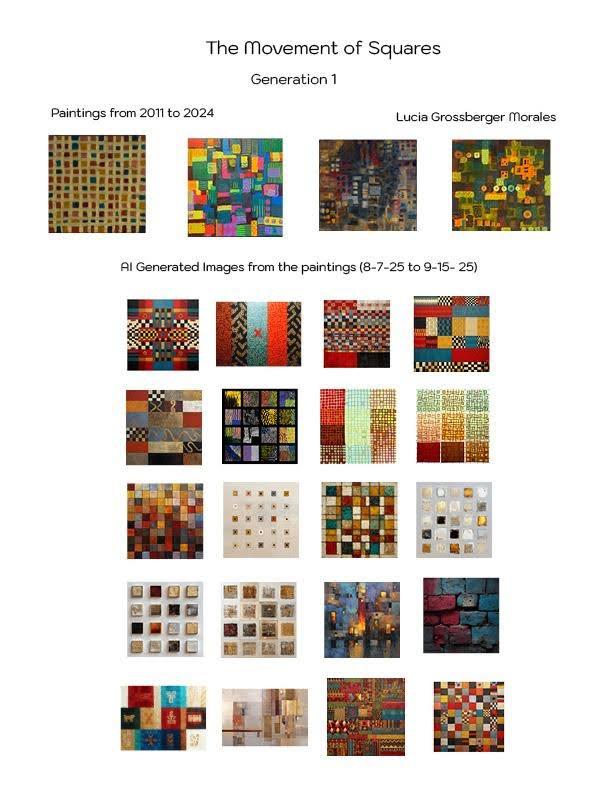
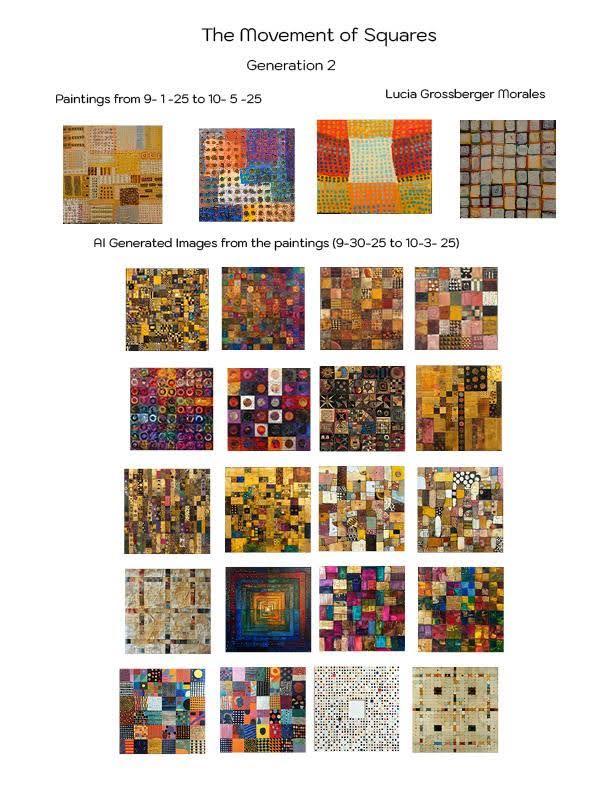
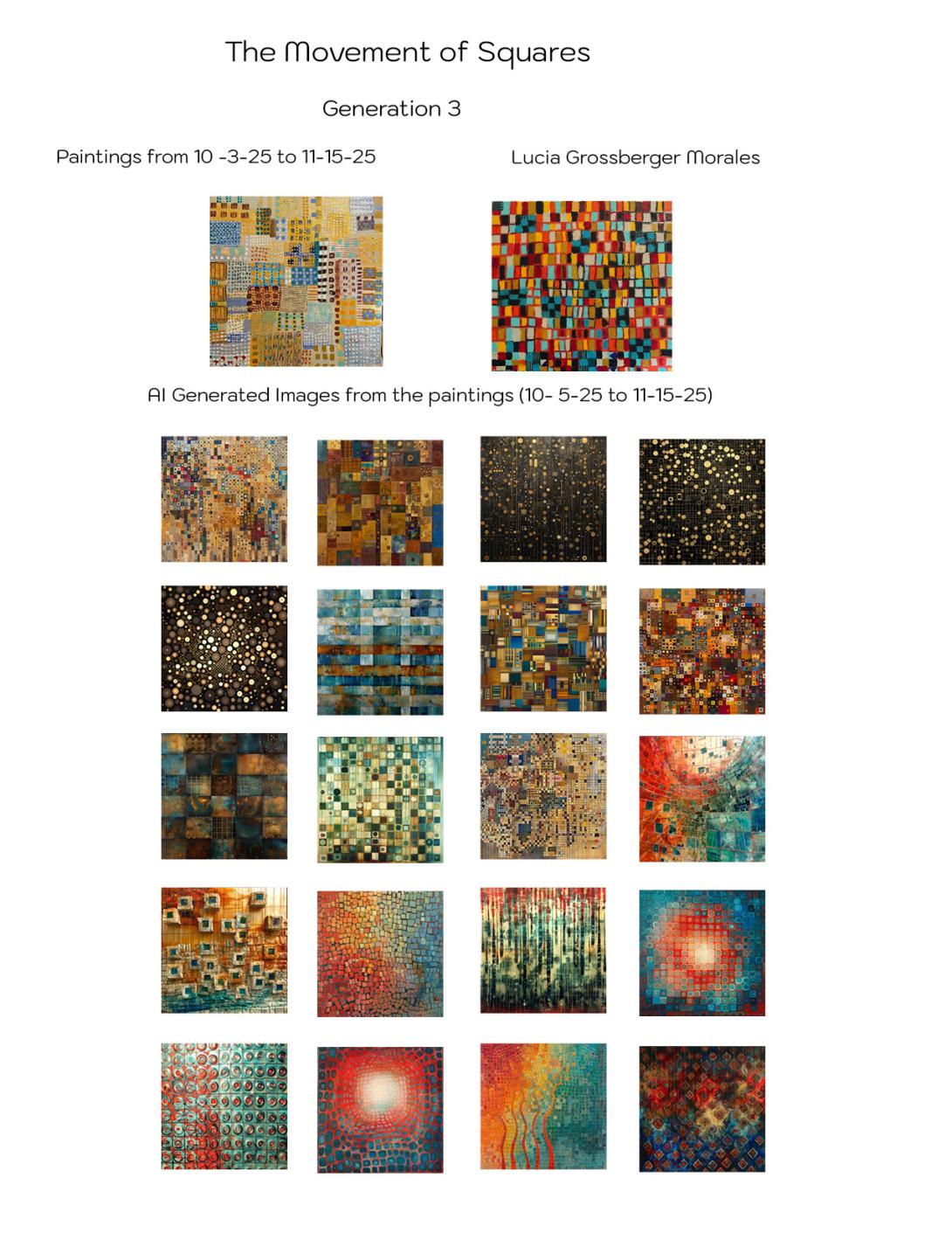
Movement in Squares was different from the beginning. I was using my handmade art as the starting point. Though the paintings are abstract, they are very personal. They are created in a visual language, and the thought of translating them into a verbal language never occurred to me. I don't even like titling my paintings, because I'm concerned it will bias the abstraction.
I had no idea how the LLMs would describe the paintings. It oddly felt transgressive to use words to describe my artwork. The descriptions were informative and accurately reflected the content. It gave words to my painting, often referencing the psychological meaning of the colors and forms. The descriptions were insightful, moving, and gave me a different perspective on my work.
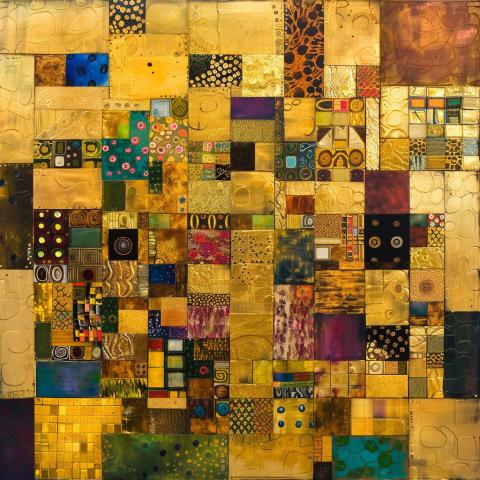
I began experimenting with LLMs, requesting unique prompts, including poems in Spanglish, using Jungian color and archetypal theory, in a poetic style of magical realism. My prompts were not describing a person or landscape-they were describing an abstract painting. The following are examples of some prompts.
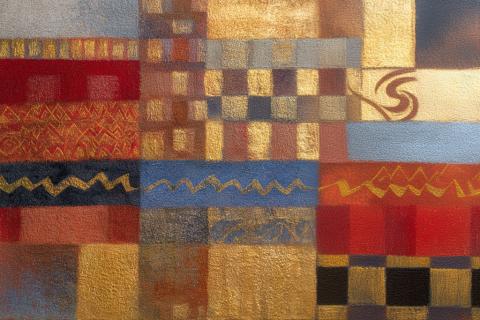
"A patchwork of golden squares, each alive with ancient marks and woven rhythms, like fragments of memory stitched into a quilt of time. Every square is its own language--dots, zigzags, stitches, grids--woven together into a luminous tapestry. A meditation on repetition, patience, and the beauty of handmade pattern."
A couple of Haikus:
"Grid of gentle hues,
Safe squares in quiet order,
Peaceful, warm embrace."
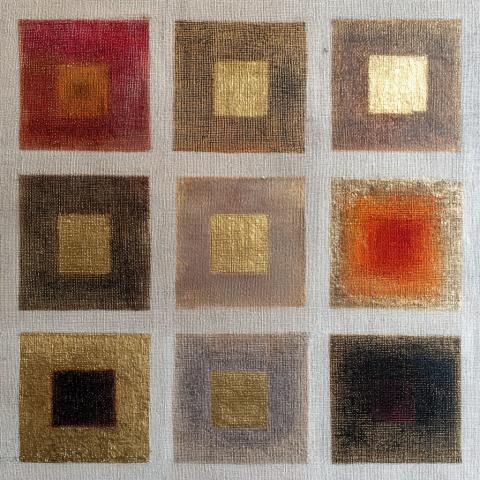
"Squares on pale canvas,
each a muted pulse of fire,
silence stitched in gold"
A few months ago, Midjourney added an option to animate an image, adding the dimension of time—a moving painting. Additionally, I created a simple WebVR space that showcases an installation of moving squares, "Text Sparks, Pixels Dance."
"Text Sparks, Pixels Dance" is a luminous VR gallery where translucent panels display abstract AI images and text prompts that cover the walls, enveloping viewers.
In my collaboration, human creativity and machine creativity interlock in a system of creation. I remain the decision maker—the painter, the one with a body, a culture, a hand. I paint, input, prompt, and evaluate; AI responds. I repaint, reinterpret, and repeat. I make the decisions, and AI is my partner. AI offers a mirror, a partner, a challenge. Together, we create cycles of interpretation and re-interpretation, as color, form, movement, and mood are transmuted into words and back again into images.
Image Process Documentation
My paintings
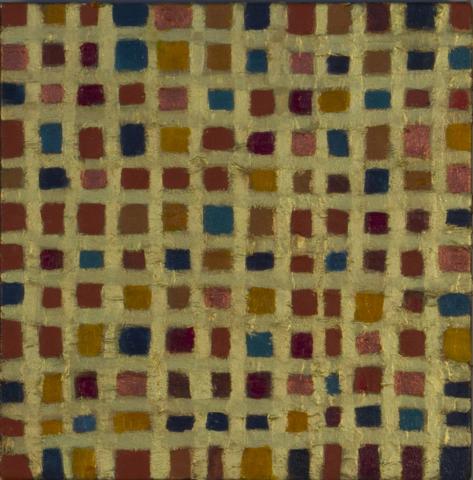
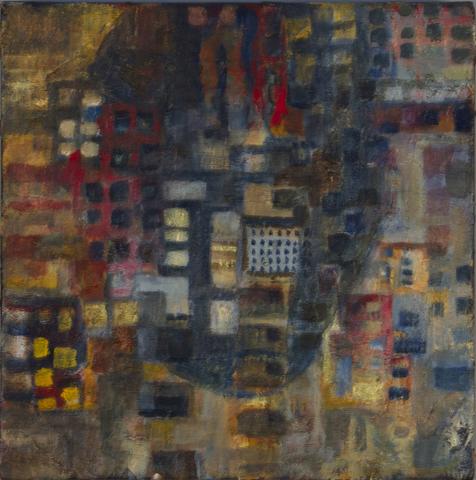
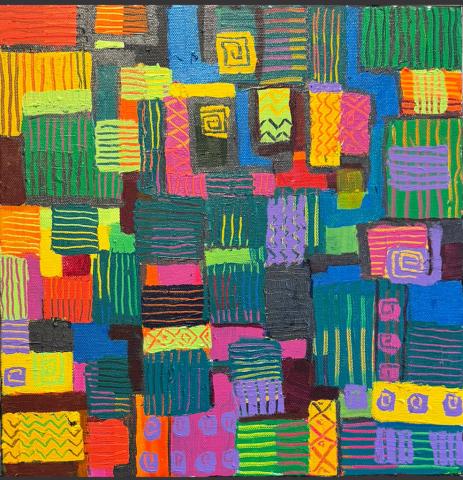
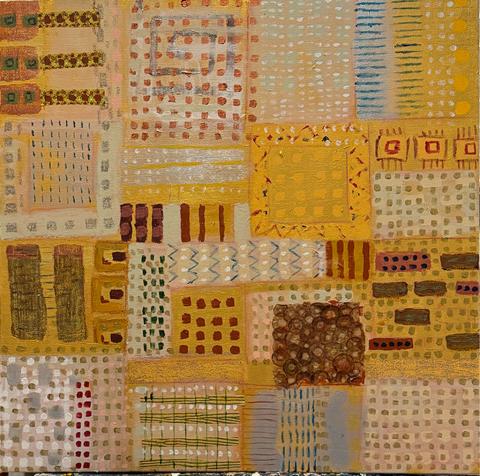
AI videos prompted by my paintings
The following media is presented as a YouTube player embedded in Able Player.
The following four videos are presented as YouTube players embedded in Able Player.
AI images prompted by my paintings
The following media is presented as a YouTube player embedded in Able Player.